
Sponsored Article: How to Use LEDs for Fast & Affordable Fluorescence
Sponsored Article: How to Use LEDs for Fast & Affordable Fluorescence
Learn how the latest 8-channel LED illumination technology offers a budget-friendly approach for capturing high-speed, multi-labelled events.
Widefield microscopes have historically required expensive motorised components to achieve high-speed, multi-labelled fluorescence imaging – but breakthrough LED light source technology has changed the game.
Over the last decade, features such as multiple channels, individual LED control, inline excitation filters and TTL triggering have built on fast LED switching speeds to provide a new approach to high-speed fluorescence. Using the 8-channel CoolLED pE-800 as an example, we explain how LED illumination has the potential to provide multi-wavelength imaging with high-speed, low cost and high signal-to-noise ratio.
No More Filter Wheels
White light sources, such as traditional lamps, can achieve high-speed, multi-wavelength imaging when used with external filter wheels. Switching speeds in the region of 55 ms are even possible, although observations are often slowed to avoid artefacts resulting from mechanical vibrations.
To overcome these latencies, LED illumination systems such as the pE-800 which feature individual channel selection can be combined with full multi-band filter sets. While this is a faster and lower-cost approach, multi-band filters must be chosen very carefully to avoid bleed-through and a resulting drop in signal-to-noise ratio.
Inline excitation filter holders solve this problem, allowing the use of single-band excitation filters from a Pinkel filter set (single-band excitation filters; multi-band emission filter and dichroic mirror). In addition to low cost and high speed, this configuration also improves the signal-to-noise ratio (Figure 1, below).
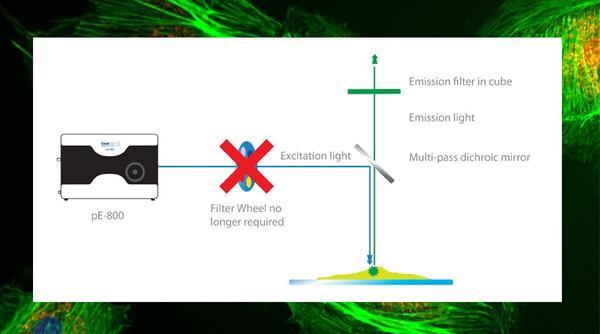
Figure 1: Individual channel switching and inline excitation filters allow a Pinkel filter configuration to replace the cost and latency of a filter wheel.
Lightning Fast TTL
The above configurations rely on third party software control, and as with any peripheral device, latencies can be introduced by USB serial communications and computer operating system overheads.
To truly capitalise on the maximum speed of LEDs, we recommend electronic control via TTL which offers switching speeds of under 7 μs with the pE-800. Cost used to be an issue due to specialist computer cards and components, but this is no longer the case with Sequence Runner.
This function uses the TTL output signal available on most scientific cameras and cycles though LEDs in a user-selected sequence for each TTL signal. Fast events can now be captured with higher temporal resolution and at lower cost. Moreover, synchronising the light source and camera exposure limits unnecessary illumination, reducing phototoxicity and photobleaching and improving data quality.
Summary
The light source might seem like an unlikely enabler for high-speed imaging, but the control that comes with the latest systems such as the CoolLED pE-800 is a world away from traditional approaches. By lowering the cost barrier, LEDs are also crucial in allowing more scientists to benefit from high-speed, high-contrast imaging.
Visit the website: www.coolled.com/products/pe-800